
Madison County Clerk Office
Madison County has a unified County Clerk rather than a separate county clerk and district clerk structure. The official Clerk page states that constitutional and statutory laws give the office five titles: Clerk of the District Court, Auditor, Recorder, Clerk of the Board of County Commissioners, and Chief Elections Officer. The same office also oversees County Assistance and Veteran Services. The research identifies Kim Hinckley Muir as Clerk of the District Court through official county candidate listings.
The county's official Clerk page is the local source for the office's five statutory titles and office role.
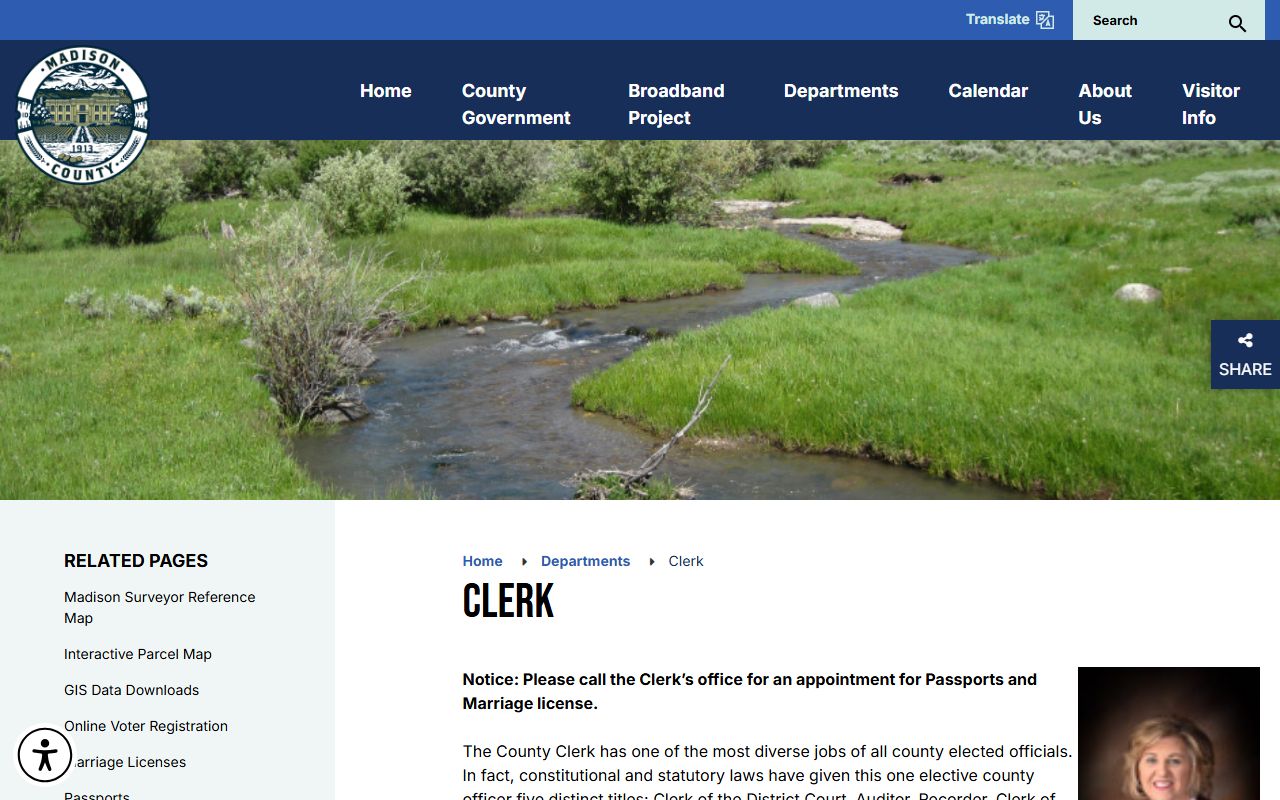
That unified structure is why one Clerk counter can matter for court records, recorded documents, marriage records, board records, and county public-record questions.
Madison County Clerk and Clerk of the District Court
Clerk: Kim Hinckley Muir
134 E Main St
Rexburg, ID 83440
208-359-6200
Use the Clerk and District Court counter for case-file copies, courthouse kiosk help, marriage documents, and local filing questions.
Madison County Clerk Duties
The Clerk's work affects nearly every record path in Madison County. As Clerk of the District Court, the office is the local custodian for trial-court files and documents filed in District Court or the Magistrate Division. As Recorder, the same office is central to recorded instruments and marriage license records. As Board Clerk and Auditor, it supports county-government records and budget work. As Chief Elections Officer, it also appears in election-result records.
- Maintain local District Court and Magistrate Division case files.
- Help with courthouse kiosk access and copies when online case summaries are not enough.
- Issue marriage licenses and receive the returned Recorder's Copy after the ceremony.
- Serve as Recorder for county recorded documents.
- Support Board of County Commissioners records and county budget duties.
- Administer election records as Chief Elections Officer.
Note: Madison County research did not identify a separate District Clerk office, so local copy should use the full Clerk and Clerk of the District Court title.
Request Madison County Certified Copies
Certified copies are used when a plain copy or online case summary is not enough. A certified court order, judgment, decree, probate letter, or filed document proves that the copy came from the official court record. The Idaho Supreme Court says general case information is available through iCourt, while records from a court case can be accessed at an Idaho courthouse kiosk or requested from the clerk where the case was filed. For Madison County, that means the County Clerk and Clerk of the District Court.
- Search iCourt first when possible and write down the Madison County case number.
- Identify the exact document needed, such as decree, order, judgment, probate letters, or docket copy.
- Contact the Madison County Clerk or use the county's public-record request channel if the document is not available online.
- Ask whether the copy must be certified and what fee applies before mailing payment or appearing in person.
- Pick up the certified copy or follow the Clerk's mailing instructions once the request is processed.
Madison County NextRequest Fields
Madison County uses NextRequest for public-record requests. The county homepage lists County Public Records Request Form and Court Public Records Request Form links, and the sheriff homepage points records requests to the same platform. NextRequest is useful when the public needs a written request channel, but court-case documents still may be governed by Idaho Court Administrative Rule 32 and handled by the Clerk where the case was filed.
The official Madison County NextRequest form exposes the request fields captured in the research.
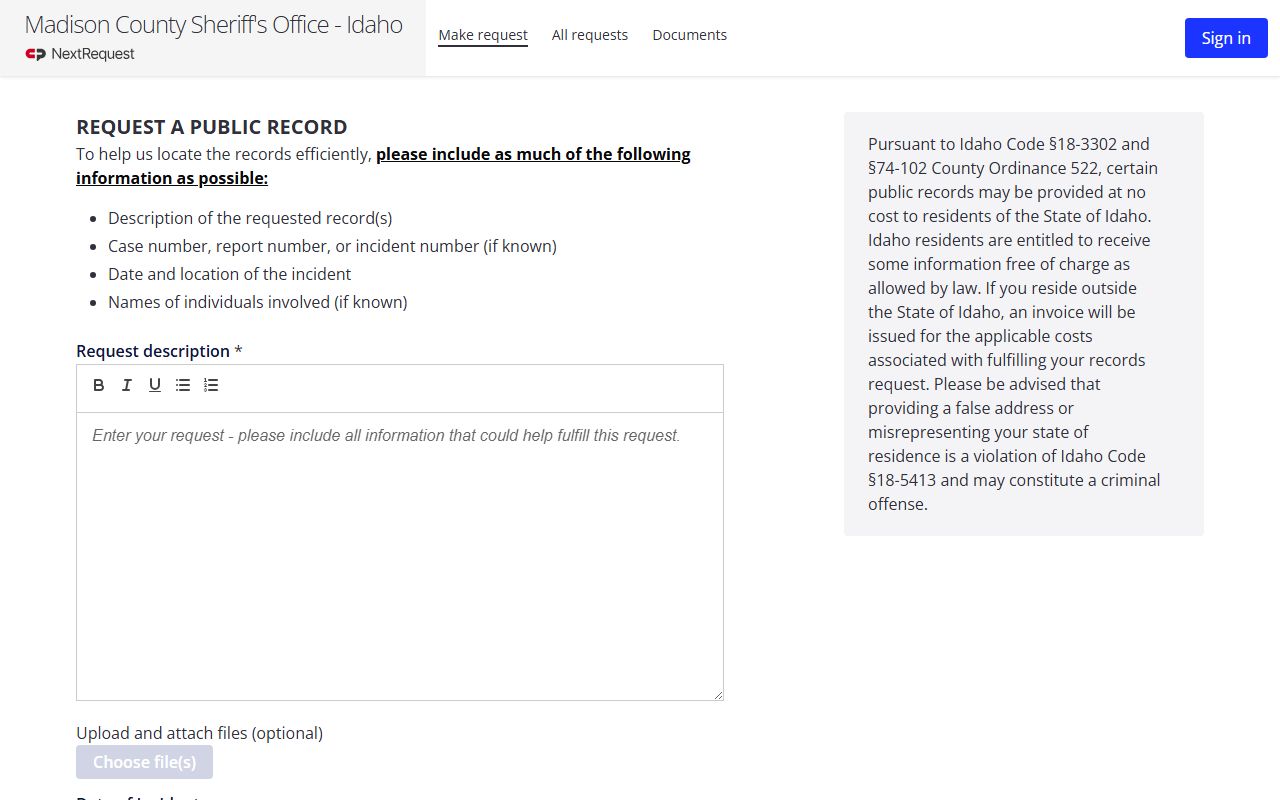
Use the case number when known. A request with only a common name may take more back-and-forth because Madison County searches can include similar names and multiple case types.
| Field label | Type | Required | Notes |
|---|---|---|---|
| Date of Incident | Datepicker | No | Endpoint metadata showed this label during inspection. |
| Case # | Text | No | Placeholder says "Type Case # Here". |
| Request format | System format options | Unspecified | Fax, Email, In person, Phone, Web, Mail, and Import were captured. |
| Requester contact fields | Web form or account fields | Unspecified | NextRequest generally needs requester identity and contact information, but exact visible labels were not fully retrievable in text inspection. |
Madison County Clerk Fees
The research found some official local fees but did not locate a complete adopted Clerk copy-fee schedule or court filing fee schedule. That gap matters because copy charges, certification charges, filing fees, and public-record production costs can differ. The table below separates found amounts from amounts that must be confirmed before a request is mailed or a filing is attempted.
| Item | Fee or cost | Source note |
|---|---|---|
| Marriage license | $28.00 | Madison County marriage license page. |
| Certified copy of marriage license | $2.00 | Madison County marriage license page. |
| Sheriff civil service fee | $70.00 per return | Sheriff's civil FAQ and service instructions. |
| Public-record copies | Not located in official local sources | Confirm with Clerk or NextRequest before ordering. |
| Court filing fees | Not located in official Madison County sources | Sheriff civil FAQ says court costs vary by division and to contact the Clerk. |
| Certified court copies | Not located in official local sources | Call the Clerk for current copy and certification charges. |
Madison County Clerk Court Records
The Clerk becomes the fallback when iCourt gives only a case summary, when a document is not downloadable, when a certified copy is needed, or when access depends on party status or a court order. The Idaho Supreme Court records guidance distinguishes general case information from records from a court case. That distinction is critical for Madison County because iCourt can help locate a case, but the Clerk is the local custodian for case-file copies.
Court-record access is governed by Idaho Court Administrative Rule 32, not only by the Idaho Public Records Act. Personal identifiers, juvenile information, medical records, mental health records, protected victim information, sealed presentence investigation reports, confidential attachments, and sealed documents may be missing or redacted from public copies. For a broader case-search path, use Madison County court records before ordering specific documents from the Clerk.
Madison County Marriage and Recorder Records
As Recorder, the Clerk also handles the Madison County marriage license record path. Applicants must call 208-359-6200 for an appointment, both applicants must be present, and licenses are accepted Monday through Friday from 9:00 AM to 3:00 PM. The local license fee is $28.00. After the ceremony, the Recorder's Copy must be returned to the office within 30 days, and a certified copy of the marriage license is available from the office for $2.00.
The manifest assigned the Madison County election results image to this Clerk page because the Clerk also serves as Chief Elections Officer.
Madison County election results are a public example of the Clerk's election-record role.
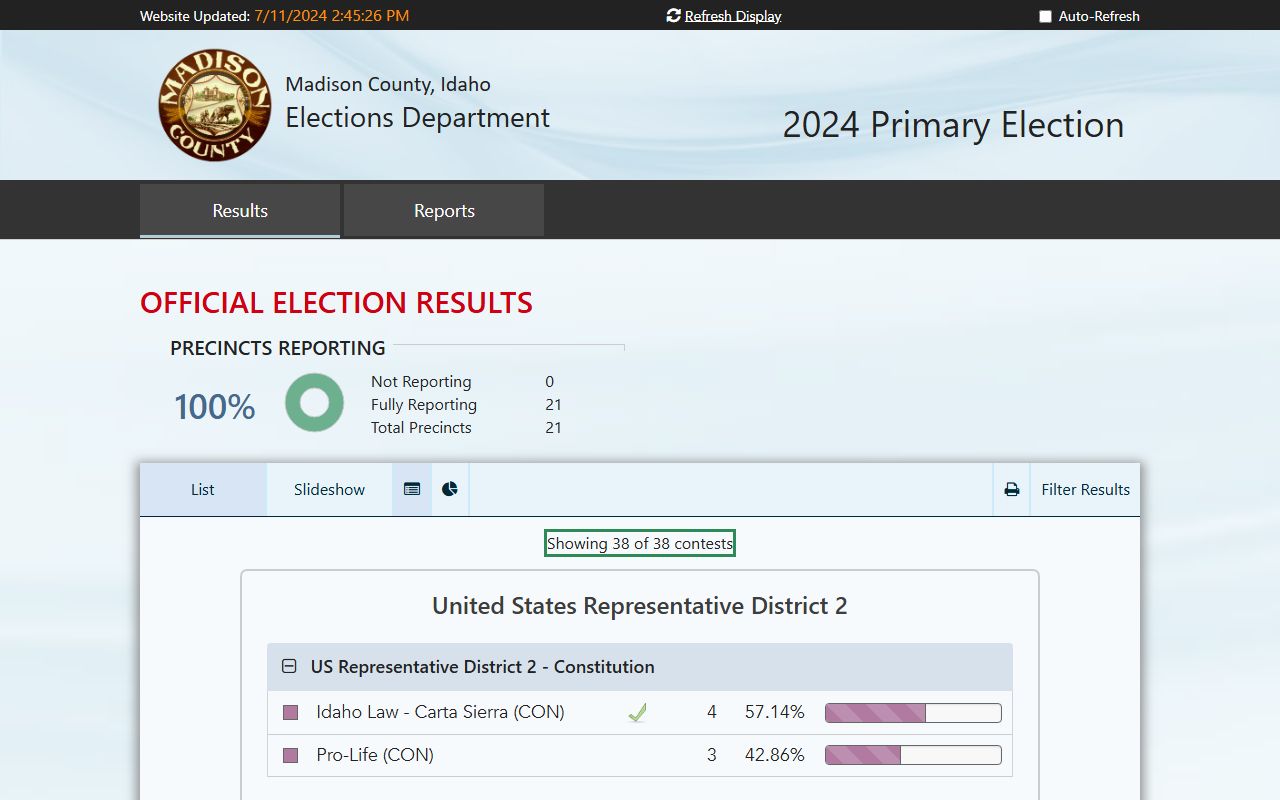
That elections function is separate from court case copies, but it shows why Madison County record requests often route back to the same elected office.
Madison County Clerk Access Rules
Use the channel that matches the record. Court summaries begin with iCourt. Court documents, certified case copies, older records, and access questions go to the Clerk of the District Court. County-government records can use NextRequest. Sheriff records, booking records, and law-enforcement reports are requested through sheriff or NextRequest channels, not through a court case file.
Idaho Code 74-102 and 74-103 support public-record access for agency records, while ICAR 32 controls Judicial Department records. For marriage licenses and recorder records, the Clerk's local instructions and Idaho marriage law control the process. When a record is sealed, juvenile, protected, or partly confidential, the Clerk may be able to explain filing logistics but cannot decide legal eligibility for the requester.